From Zero to Website in Hours: The AI-Powered Builder's Playbook for 2024
Five years ago, launching a professional website meant choosing between two painful options: hire a developer for $5,000+ or learn web development yourself. Today, that equation has flipped entirely.
AI is reshaping how websites get built—and it's happening faster than most people realize. Whether you're a freelancer building a portfolio, a small business owner launching an online store, or an entrepreneur proving a concept, website building with AI has moved from "nice to have" to "how most smart people do it in 2024."
But here's what most guides miss: AI isn't a magic button. It's a set of interconnected tools that work best when you understand what each one does—and how to layer them together. This guide walks you through the real playbook that beginners and busy professionals are using right now to ship professional websites in days instead of months.
Why AI Changes Everything About Website Building in 2024
Let's get specific about what's changed. Traditional website creation with ai used to mean hiring expensive agencies or wrestling with bloated page builders. Both approaches had the same problem: they locked you into slow, inflexible workflows.
AI flips this on its head by handling three critical bottlenecks simultaneously:
- Content creation – Instead of staring at a blank page for hours, AI generates headlines, product descriptions, landing page copy, and blog content in minutes. You edit and refine, but the heavy lifting is done.
- Design decisions – AI tools now analyze your industry, competitors, and audience to suggest layouts, color schemes, and copy structures that actually convert. You're not starting from scratch.
- Technical execution – No-code platforms powered by AI handle hosting, security, SEO optimization, and deployment. You focus on content and strategy; the platform handles the plumbing.
The result? A freelancer can now produce a professional portfolio website in a weekend. A solopreneur can launch an e-commerce site with product descriptions and marketing copy without hiring a copywriter. This wasn't possible at scale two years ago.
The Three-Layer AI Stack That Actually Works
Here's where most beginners stumble: they grab one AI tool, realize it doesn't do everything, and get frustrated. The mistake is thinking you need a single "all-in-one" solution.
Instead, successful website development with ai uses three complementary layers that work together:
Layer 1: Content Generation (The Brain)
This is where AI writes your website's actual words—headlines, page copy, product descriptions, meta tags, and blog content. Tools like ChatGPT, Claude, and specialized copywriting AI can generate high-quality content in seconds.
The key: You're not replacing writers; you're replacing the blank-page problem. Feed AI your product details, target audience, and brand voice. It generates 5-10 variations. You pick the best, tweak it, and publish. What used to take a copywriter 4 hours takes 20 minutes.
Real example: A freelance designer building a client portfolio site used AI to write 15 project descriptions in 30 minutes. Normally this takes a day of interviews and rewrites. She edited them to match her voice, and they were ready to publish.
Layer 2: Site Building & Layout (The Structure)
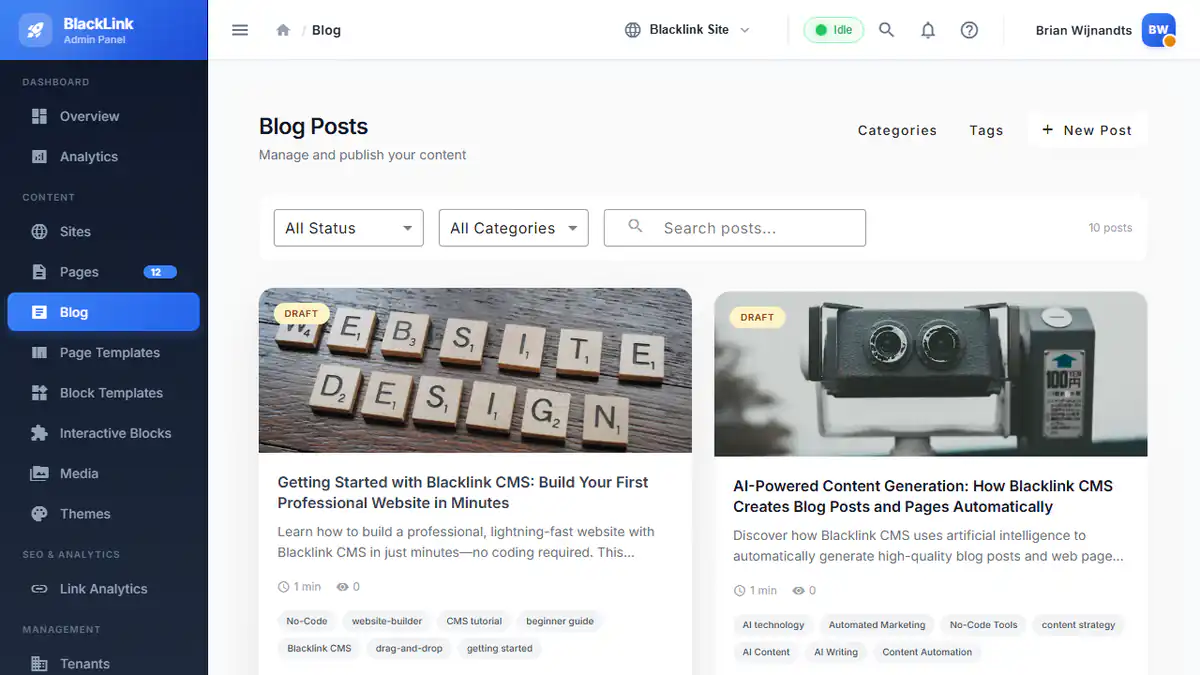
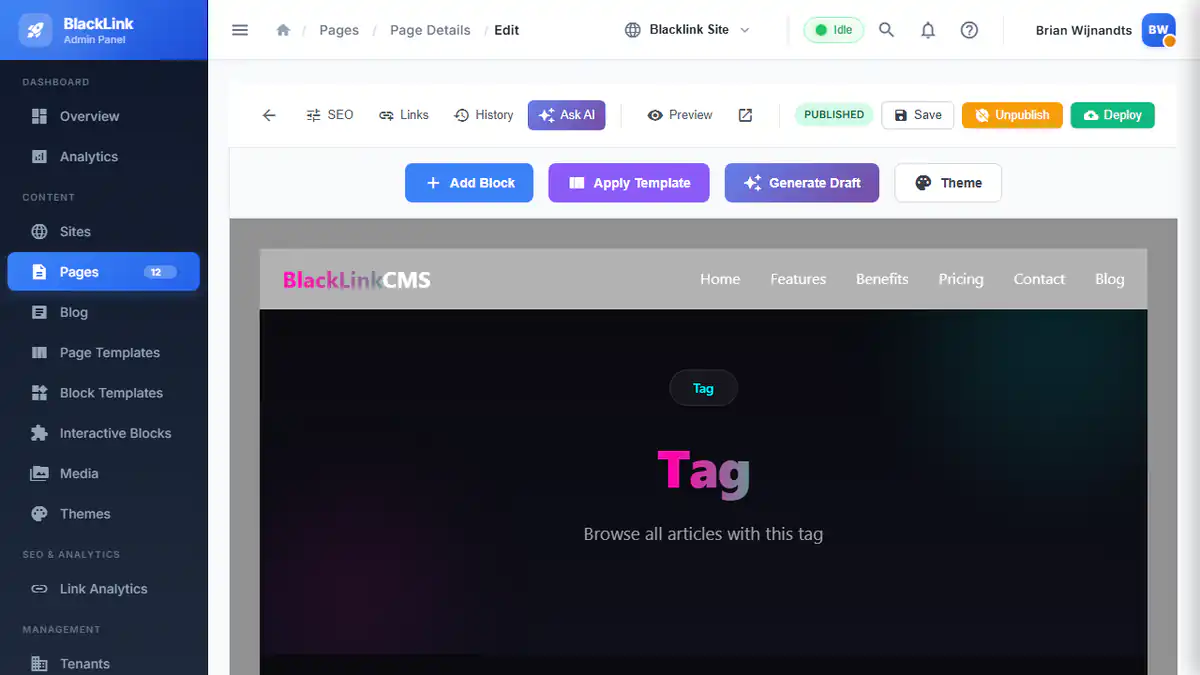
This is your no-code platform—the foundation where your website actually lives. Modern platforms like Blacklink CMS combine AI-powered content creation with lightning-fast static site generation, eliminating the need for traditional hosting infrastructure.
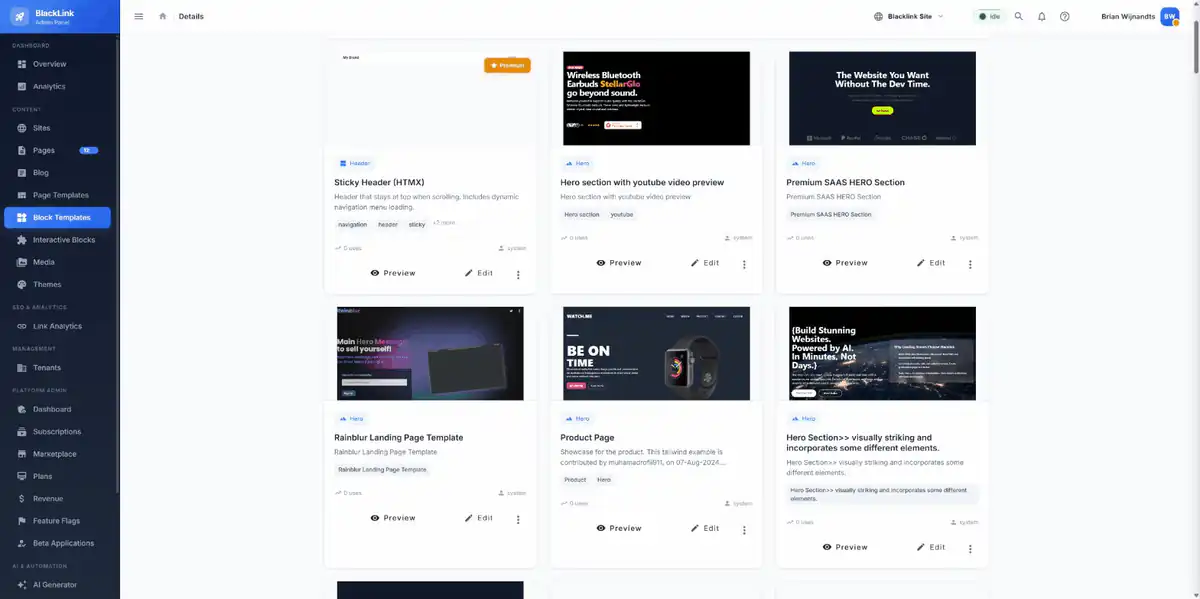
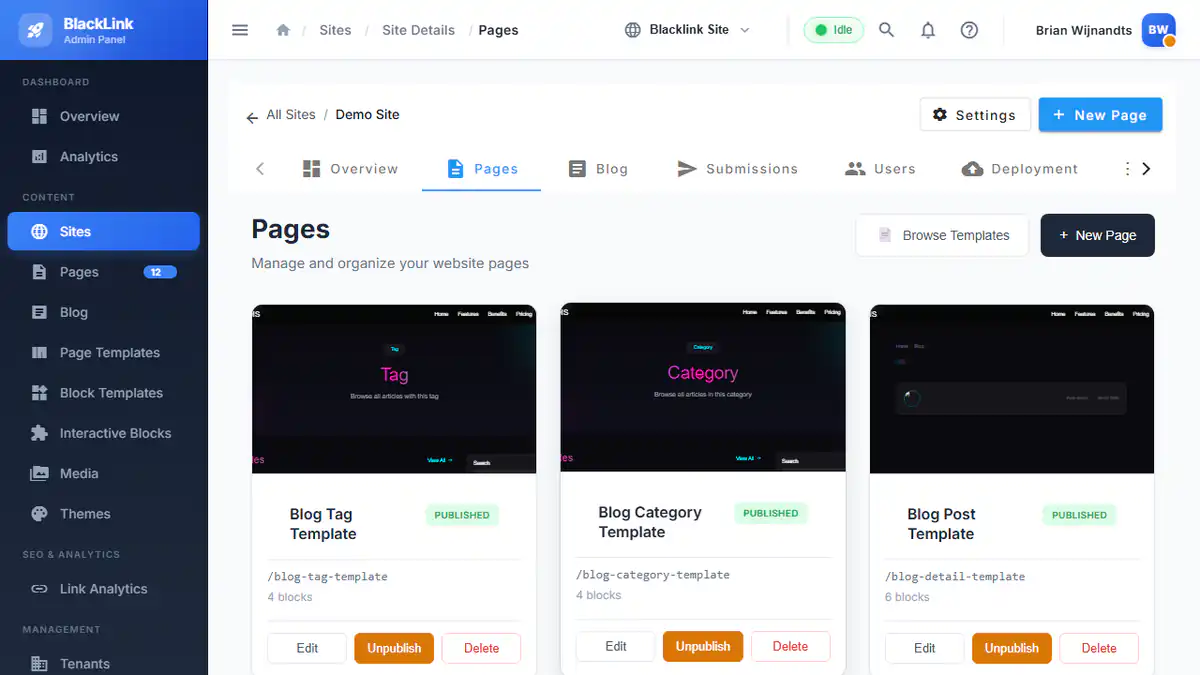
What matters: The platform should handle SEO automatically, provide templates that AI can enhance, and let you publish without touching code. Website making with ai requires a builder that understands modern web standards—not a clunky page builder from 2015.
Layer 3: Optimization & Analytics (The Feedback Loop)
After you publish, AI helps you understand what's working. Tools analyze traffic patterns, suggest content improvements, and identify SEO gaps. This closes the loop—you're not shipping and praying; you're shipping and learning.
The combination is powerful: AI writes content → platform publishes it → analytics show what resonates → AI helps you refine. Rinse and repeat.
Best AI Tools for Website Building in 2024: What Actually Works
Here's the honest breakdown of tools people are actually using right now:
| Category | Top Tools | Best For |
|---|---|---|
| Content Writing | ChatGPT, Claude, Copy.ai | Bulk copy generation, headlines, product descriptions |
| Website Builder | Blacklink CMS, Webflow, Framer | Fast deployment, SEO-ready, minimal maintenance |
| Image Generation | Midjourney, DALL-E, Leonardo.AI | Hero images, product mockups, custom visuals |
| SEO Optimization | Surfer SEO, Semrush, Ahrefs | Keyword research, content optimization, competitor analysis |
A practical note: You don't need all of these. Most beginners get great results with ChatGPT + a solid builder + one SEO tool. The expensive enterprise suites are overkill when you're starting out.
The Realistic Timeline: From Idea to Live Website
Let's walk through what a real timeline looks like when you combine website building with ai properly:
- Day 1 (2-3 hours): Define your website's purpose, target audience, and core pages. Sketch out structure. Start with your AI content generator—write briefs for each page ("Landing page explaining our copywriting service for freelancers"). AI generates first drafts.
- Day 2 (2-3 hours): Edit content. Generate variations for key sections. Create 5-10 headlines and test them mentally. Add brand voice and specificity. Meanwhile, choose your website builder platform and pick a template that matches your vibe.
- Day 3 (3-4 hours): Build out pages in your platform. Plug in AI-generated content. Add images (AI-generated or stock). Set up basic SEO (title tags, meta descriptions—AI can help with these too). Test on mobile.
- Day 4 (1-2 hours): Final polish. Preview. Deploy.
Total: 8-12 hours of actual work across 4 days. Compare that to traditional timelines of 4-8 weeks. This is why AI is fundamentally changing who can launch a professional web presence.
Important caveat: This assumes you have clarity on what you're building. If you're still figuring out your positioning or messaging, add a day or two for strategy. AI is great at execution; it's less helpful at deciding what to execute.
The Free vs. Paid Reality Check
Everyone wants to know: Can you build website with ai free? The honest answer: Partially.
What's free: AI content generators (ChatGPT free tier, Claude free trial), many website builders offer free plans, image generation trials, basic SEO tools.
What costs money (and is worth it): Hosting that doesn't insert ads, premium website builder features, advanced AI tools with better quality output, reliable analytics.
For most beginners, a minimal setup costs $20-50/month. That's hosting, a builder, and premium AI tool access. It's objectively cheaper than hiring anyone to build anything, and you maintain complete control.
One critical insight many people miss: fully automated AI generation without strategic human review usually produces mediocre results. You want tools that save time, but demand your judgment on what matters. Budget time for editing, not just generation.
Common Mistakes People Make (And How to Avoid Them)
After watching dozens of people build websites with AI, patterns emerge:
- Mistake: Using AI-generated copy verbatim. AI creates a solid foundation, not final copy. Add specificity, examples, and your unique perspective. Generic AI copy doesn't convert.
- Mistake: Picking the wrong website builder. Some builders are slow, bloated, or poor at SEO. Modern static site builders outperform traditional platforms on speed and security—this matters for both user experience and rankings.
- Mistake: Ignoring SEO during the build phase. It's 10x easier to optimize while building than to retrofit. Use AI to generate SEO-friendly titles, meta descriptions, and heading structures from the start.
- Mistake: Launching too fast without testing. Preview your site on mobile. Click every link. Read every line of copy aloud. AI-generated content sometimes has subtle awkwardness that jumps out when you engage with it.
- Mistake: Treating it as "set and forget." A website built with AI today still needs updates, fresh content, and optimization next month. The AI tools handle creation speed; you handle strategy.
Getting Started: Your First 24 Hours
Ready to actually do this? Here's your action plan:
- Hour 1: Write a 1-paragraph description of what your website is for. Who visits it? What should they do when they arrive? This brief becomes your AI prompt.
- Hour 2-3: Use ChatGPT or Claude to generate content for your main pages. Copy the outputs into a document. Read them out loud. Note which sections feel right and which need tweaking.
- Hour 4: Choose a website builder. Set up an account. Pick a template that matches your industry.
- Hour 5-8: Build pages. Add your AI-generated content. Edit for voice and specificity. Add images.
You'll have a live website before dinner. Will it be perfect? No. Will it be professional and functional? Absolutely.
The Future: AI as Your Web Development Partner
The trajectory is clear: website development with ai is becoming the standard workflow, not the exception. In 2024, the competitive advantage isn't whether you use AI—it's how intelligently you use it.
Smart builders combine AI content generation with platforms that handle hosting, security, and performance automatically. They understand that a great website comes from the intersection of AI efficiency and human judgment. They know that speed matters, but quality matters more.
For teams and agencies scaling client projects, this means rethinking entire workflows—from how content gets created to how sites get deployed. The organizations moving fastest aren't the ones with the biggest budgets; they're the ones using AI strategically to multiply their team's output.
The beautiful part? You can start today. You don't need permission. You don't need a developer. You don't need months of lead time. Pick a builder, open an AI tool, and start shipping.
Your Move
Website building with ai has crossed from "emerging trend" to "practical reality" in 2024. The tools are accessible, the timelines are realistic, and the results speak for themselves.
Whether you're building your first site or your tenth, the fundamentals are the same: use AI to handle content generation and optimization, choose a modern builder that doesn't slow you down, and apply your judgment to make it actually good.
The question isn't whether to use AI in your next website project—it's whether you'll use it strategically or fall behind teams that do.
Ready to build? Start with a solid platform that combines speed, SEO, and AI-powered content creation. Your website—and your timeline—will thank you.